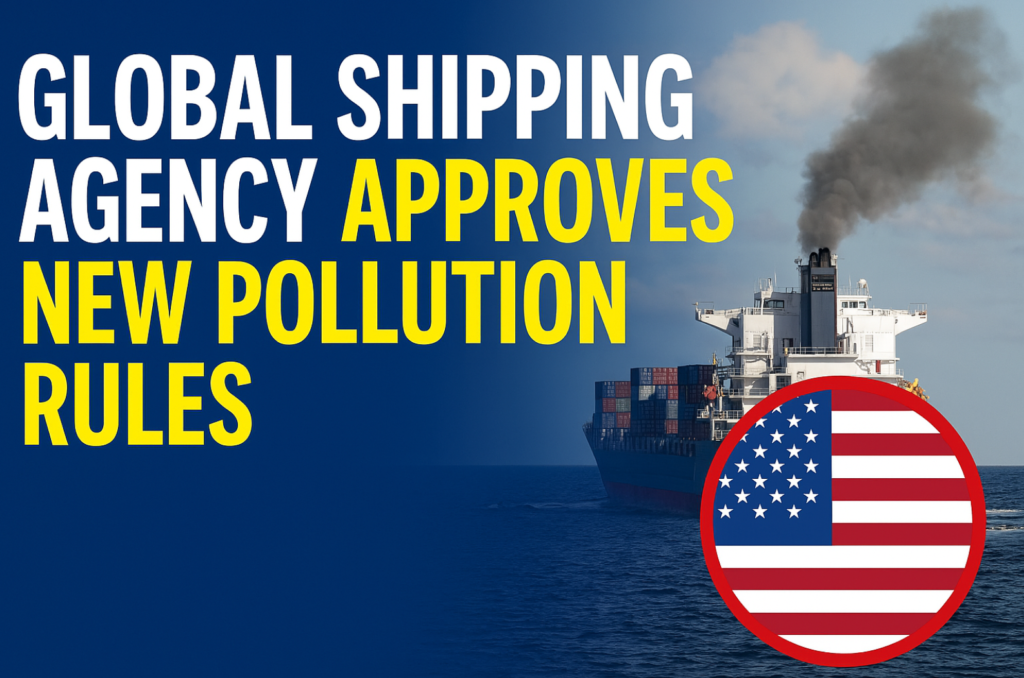
Countries around the world have agreed to strict new rules to reduce pollution from ships. The decision was made on Friday by the International Maritime Organization (IMO), a United Nations agency. However, the U.S. disagreed with the plan and left the talks early.
The new rules aim to cut harmful emissions from ships by 20% by 2030. The long-term goal is to eliminate all emissions by 2050. To achieve this, the IMO will introduce two pollution limits starting in 2028. Ships that pollute less than the stricter limit will get rewards, while those that exceed the main limit will face fines.
The U.S. walked out of the talks in London this week. It urged other countries to do the same and warned it would take action if American ships were charged fees. Despite this, most nations supported the plan, seeing it as a necessary step to fight climate change.
How the New System Will Work
From 2028, ships must follow two pollution standards:
- Main Limit: All ships must stay below this level.
- Stricter Limit: Ships that pollute less than this will earn rewards.
If a ship emits more than the main limit, it will be fined
Here’s how the penalty system works:
- Ships that go over the first (basic) limit will be fined $380 per metric ton of CO2 released beyond that level.
- Ships that exceed the stricter limit but still remain under the basic cap will pay a lower penalty of $100 per ton.
- Vessels that stay well below the strict level will earn carbon credits. These credits can be sold to other ships that are not meeting the standards.
For example:
- By 2030, ships must cut emissions by 8% compared to 2008 levels to meet the main limit. The stricter limit requires a 21% reduction.
- By 2035, the main limit tightens to 30%, while the stricter limit becomes 43%.
Cleaner ships will earn credits, which they can sell to ships that fail to meet the standards.
Not all countries supported the plan. Some, like China, Brazil, and Saudi Arabia, opposed a stronger carbon tax proposed by the European Union and Pacific nations. The final agreement was reached after compromises.
Saudi Arabia, Russia, and Iran even demanded a vote—something rare at the IMO, where decisions are usually made by agreement.
The rules still need final approval at an IMO meeting in October. If passed, they will take effect in 2028.
This decision marks a big step in reducing shipping pollution, but challenges remain. With the U.S. opposing the fees, future tensions could arise over how these rules are enforced globally.
The world’s shipping industry, responsible for nearly 3% of global CO₂ emissions, is now under pressure to go green—whether all nations agree or not.

Recent Posts
Could Gold (XAU/USD) Cross $6,000 in the Coming Months?
Tukaram Mundhe Biography: Age, Education, IAS Career, Wife, Family, Salary, Net Worth & More
NISM-Series-XV: Research Analyst Certification Examination
NISM-Series-II-A: Registrars to an Issue and Share Transfer Agents (Corporate) Certification
NISM-Series-I: Currency Derivatives Certification Examination
Ravneet Singh Bittu: Biography, Age, Education, Wife, Political Career, Net Worth & More
Pawan Kumar Chandana: Biography, Age, Education, Net Worth, Wife, Skyroot Aerospace & More
Aryan Kelvin (Aman Pandit): Age, Biography, Height, Village, Net Worth & More
OFSS Bihar Portal 2026: Complete Guide for 11th Admission, Login, Merit List & Spot Admission
Skyroot Aerospace Vikram-1 Launch: India's First Private Orbital Rocket Set for Historic Mission
Abhijeet Dipke Joins Protest at Jantar Mantar, CJP Raises Concerns Over Civil Rights
JPMorgan Invests $24 Million to Boost US Shipbuilding Industry