Gold has always had a reputation for being the asset people turn to when confidence in currencies, governments, or financial markets starts to weaken.
But in 2026, the gold story has become much bigger.
After reaching record levels above $5,500 earlier this year and then experiencing a sharp correction below $4,000, XAU/USD has once again started showing serious strength. As of August 21, spot gold was trading around $4,560, with the metal heading toward its third consecutive weekly gain.
That raises an interesting question:
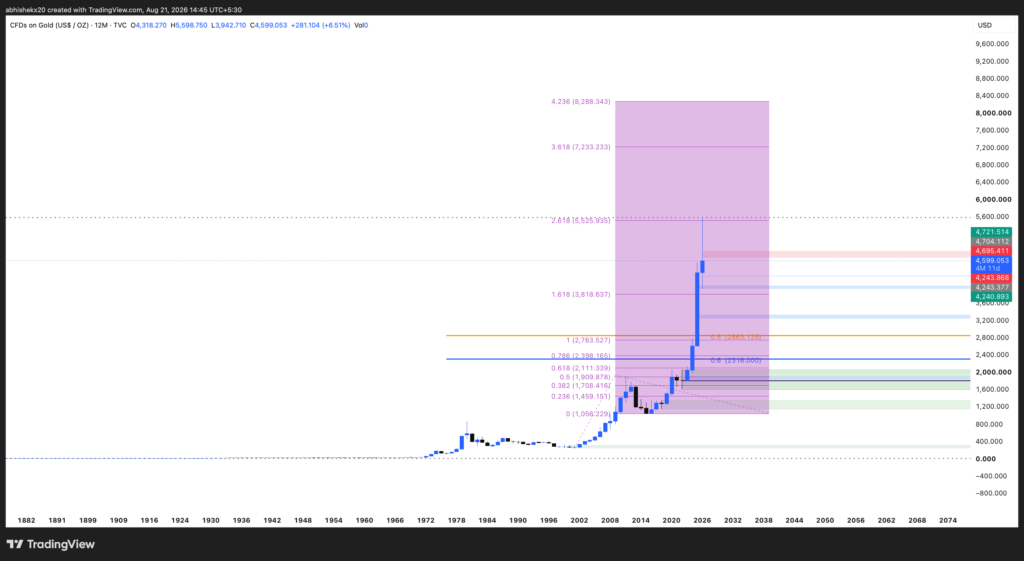
Can gold realistically trade above $6,000 in the coming months?
I believe it is possible but it would require more than just technical momentum.
The $6,000 target is no longer unrealistic
A move from approximately $4,560 to $6,000 would require a gain of roughly 32%.
That sounds extreme.
But gold has already demonstrated that it can move hundreds of dollars in a relatively short period when macroeconomic conditions align.
In January 2026, gold pushed above $5,500 before suffering a major correction. The fact that the market was able to reach those levels once means $6,000 is no longer some impossible psychological number.
In fact, J.P. Morgan’s Global Research has projected that gold could reach around $6,000 per ounce by the end of 2026, with $6,300 possible in 2027.
So the question isn’t really whether $6,000 is possible.
The bigger question is:
What could push gold from $4,500–$4,600 toward $6,000?
1. Central banks are still an important source of demand
One of the biggest structural reasons behind the long-term gold bull case is central-bank buying.
Unlike short-term traders, central banks generally aren’t buying gold because of a 15-minute chart pattern.
They are looking at reserves, currencies, geopolitical risk and long-term financial stability.
Central-bank demand has remained an important support for gold even during periods when investor demand has weakened. Reuters recently noted that central banks are still viewed as relatively dependable buyers of gold.
If this demand continues while investment demand increases, the market could become significantly tighter.
2. The U.S. dollar could become another catalyst
Gold and the U.S. dollar often have an inverse relationship.
When the dollar weakens, gold becomes relatively cheaper for buyers using other currencies.
And recently, this relationship has been visible again.
On August 21, gold climbed toward $4,600 as the dollar weakened and Treasury-market developments pushed investors toward gold. Reuters reported spot gold around $4,562.86, up about 4.2% for the week.
If the dollar enters a prolonged period of weakness, gold could receive another major tailwind.
3. U.S. debt and fiscal concerns are becoming increasingly important
This is perhaps one of the most interesting parts of the gold story.
Gold isn’t only trading on inflation or interest-rate expectations anymore.
Investors are increasingly looking at the sustainability of government debt and fiscal policy.
The U.S. national debt has moved above $40 trillion, and concerns around government borrowing and the long-term value of fiat currencies can increase demand for hard assets such as gold.
The recent U.S. Treasury decision to expand long-term bond buybacks has also reignited discussions about potential dollar debasement and financial repression. Gold responded strongly to the news.
If markets begin to believe that governments will prioritize managing borrowing costs over maintaining a strong currency, gold could benefit significantly.
4. Lower yields could accelerate the move
Gold doesn’t pay interest.
That normally makes it less attractive when real yields are high.
But when bond yields fall, the opportunity cost of holding gold decreases.
This is exactly what we have recently seen.
Gold broke above $4,500 after U.S. Treasury-market developments pushed long-term yields lower.
If the Federal Reserve eventually moves toward easier monetary policy while inflation remains elevated or fiscal concerns continue the environment could become particularly favorable for gold.
5. Geopolitical risk hasn’t disappeared
Gold’s safe-haven characteristic remains one of its biggest strengths.
The geopolitical environment in 2026 has already demonstrated how quickly gold can move when investors become concerned about global stability.
However, there is an important lesson here.
Gold doesn’t necessarily rise immediately during a crisis.
During the Iran conflict earlier this year, gold actually experienced a huge sell-off as investors rushed toward liquidity. It subsequently recovered strongly, rising roughly 9% in August toward $4,400.
That tells us something important:
Gold’s long-term safe-haven demand can be bullish, but the path will not be straight.
The technical picture matters
From a trading perspective, I wouldn’t simply say:
“$6,000 is coming, so buy gold.”
That’s not how markets work.
Gold could easily experience another 5–10% correction before continuing higher.
The important levels are going to develop as the market progresses.
The recent move above $4,500 is significant because gold has returned to an area that previously acted as a major barrier. Some analysts are watching the $4,650 region as an important resistance zone, with a sustained breakout potentially opening the door toward $4,900 and beyond.
For me, the bigger confirmation would be a combination of:
Higher highs + higher lows + weakening dollar + falling real yields + continued central-bank demand.
If those factors continue aligning, the probability of a much larger move increases.
But there is a major risk to the $6,000 thesis
We also need to talk about the other side.
Gold doesn’t automatically go to $6,000 just because analysts have bullish targets.
A stronger-than-expected U.S. economy, rising real yields, a stronger dollar, easing geopolitical tensions or aggressive Federal Reserve policy could put significant pressure on gold.
The World Gold Council’s mid-year outlook, for example, highlighted that gold’s performance is highly sensitive to geopolitical developments, investor sentiment and monetary-policy expectations.
And not every forecast is bullish.
A Reuters survey of 29 analysts in July produced a median 2026 gold forecast of around $4,509, considerably below $6,000.
That’s why $6,000 should be viewed as a bull-case scenario, not a guaranteed destination.
So, can XAU/USD reach $6,000?
Yes, I think it is possible.
But I wouldn’t expect gold to travel from $4,500 to $6,000 in a straight line.
A more realistic path could look something like:
$4,500 → $4,650 → $5,000 → $5,300 → $5,600 → $6,000
with corrections and periods of consolidation between those levels.
The interesting part is that the market has already shown it can trade above $5,000 this year.
The next major challenge is whether gold can establish itself above its previous highs and turn those levels into support.
If that happens while the dollar weakens, yields fall, central banks continue accumulating gold and geopolitical/fiscal risks remain elevated, $6,000 could move from an ambitious forecast to a realistic bull-market target.
My view
I don’t think the $6,000 target should be treated as a prediction carved in stone.
I see it as a scenario.
If macroeconomic conditions continue favoring gold, XAU/USD could potentially make another explosive leg higher over the coming months.
But traders should remember one thing:
A bullish thesis does not mean buying every dip.
Gold can be extremely volatile.
The better approach is to watch market structure, key support and resistance levels, liquidity, the dollar, Treasury yields and the broader macro environment.
Because if gold really does make a move toward $6,000, the biggest opportunity may not come from predicting the exact top.
It may come from recognizing the trend early and having the discipline to survive the pullbacks along the way.
$6,000 gold may sound aggressive today.
But after everything gold has already done in 2026, it is no longer an impossible number.**
For Advertising, Guest Posting, Newsletter Inserts please contact editor@moneyphobia.in. For general enquiries contact cfo@moneyphobia.in.

Recent Posts
Could Gold (XAU/USD) Cross $6,000 in the Coming Months?
Tukaram Mundhe Biography: Age, Education, IAS Career, Wife, Family, Salary, Net Worth & More
NISM-Series-XV: Research Analyst Certification Examination
NISM-Series-II-A: Registrars to an Issue and Share Transfer Agents (Corporate) Certification
NISM-Series-I: Currency Derivatives Certification Examination
Ravneet Singh Bittu: Biography, Age, Education, Wife, Political Career, Net Worth & More
Pawan Kumar Chandana: Biography, Age, Education, Net Worth, Wife, Skyroot Aerospace & More
Aryan Kelvin (Aman Pandit): Age, Biography, Height, Village, Net Worth & More
OFSS Bihar Portal 2026: Complete Guide for 11th Admission, Login, Merit List & Spot Admission
Skyroot Aerospace Vikram-1 Launch: India's First Private Orbital Rocket Set for Historic Mission
Abhijeet Dipke Joins Protest at Jantar Mantar, CJP Raises Concerns Over Civil Rights
JPMorgan Invests $24 Million to Boost US Shipbuilding Industry