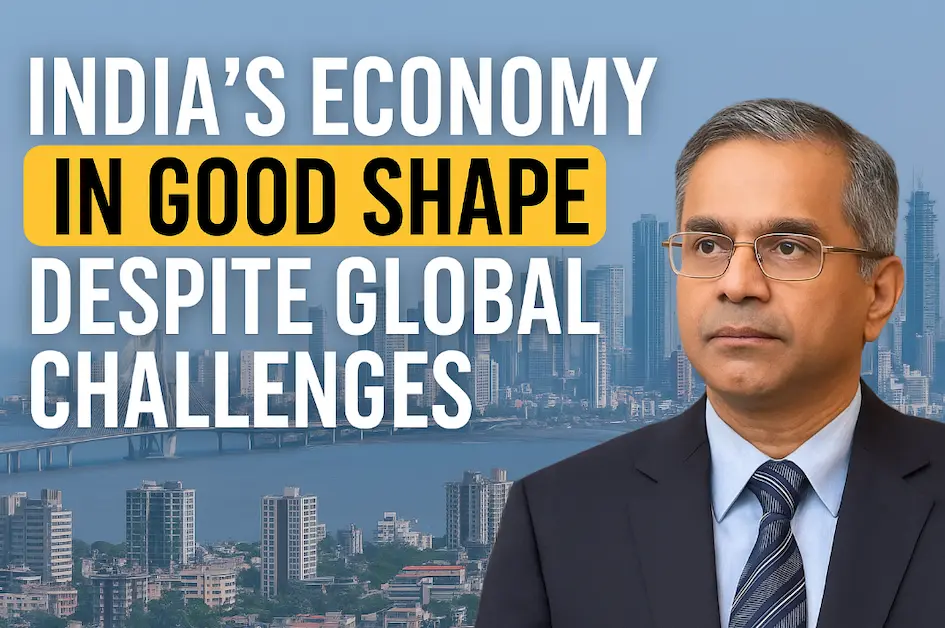
Even as the world faces economic uncertainty, India is holding its ground. Chief Economic Advisor Dr. V Anantha Nageswaran recently said that India’s economy is in “good shape”, backed by solid numbers and smart policymaking.
Speaking at an event hosted by Ashoka University, Dr. Nageswaran pointed to current trends that show steady growth, strong fundamentals, and optimism for the future—even as global markets continue to face turbulence.
Positive Indicators Amid Global Turmoil
Dr. Nageswaran made it clear: India isn’t just surviving, it’s moving forward. While the final GDP numbers for FY25 will be out soon, early data is already painting a promising picture.
He emphasized that macroeconomic stability remains a top priority—meaning policies are aimed at balancing inflation, growth, and investment. The goal? Growth that’s not only fast, but also fair and inclusive.
According to him, India must continue investing in human capital, infrastructure, innovation, and structural reforms. These are the levers that will push the economy forward and help build long-term resilience.
India Poised for Global Leadership
Adding to the optimism, the International Monetary Fund (IMF) in its April 2025 forecast projected India’s economy to grow by 6.2% in 2025 and 6.3% in 2026. That makes India the fastest-growing major economy for the foreseeable future.
This strong performance comes despite global headwinds like high interest rates, energy price shocks, and trade tensions. It’s a sign that India is not just reacting to global changes, but strategically adapting to them.
Focus Areas for Future Growth
Dr. Nageswaran outlined key sectors where India must double down:
- Affordable energy and green transition
- Jobs and upskilling, especially with AI
- Improved education and food security
- Private sector investment and support for MSMEs
- Equity between labor and capital earnings
Vision 2047: India as a Developed Nation
Suman Bery, Vice Chairman of NITI Aayog, also shared his vision at the same event. He reminded the audience that India aims to become a developed, high-income country by 2047—just in time for its 100th year of independence.
He believes this vision is realistic, but it requires action now.
“We’ve averaged a 6.5% growth rate for three decades. That’s not luck, it’s policy consistency and institutional maturity,” Bery noted.
He added that India can turn global uncertainty into opportunity—by tapping into its young workforce, adopting new technologies, and repositioning itself in global supply chains.

Recent Posts
Could Gold (XAU/USD) Cross $6,000 in the Coming Months?
Tukaram Mundhe Biography: Age, Education, IAS Career, Wife, Family, Salary, Net Worth & More
NISM-Series-XV: Research Analyst Certification Examination
NISM-Series-II-A: Registrars to an Issue and Share Transfer Agents (Corporate) Certification
NISM-Series-I: Currency Derivatives Certification Examination
Ravneet Singh Bittu: Biography, Age, Education, Wife, Political Career, Net Worth & More
Pawan Kumar Chandana: Biography, Age, Education, Net Worth, Wife, Skyroot Aerospace & More
Aryan Kelvin (Aman Pandit): Age, Biography, Height, Village, Net Worth & More
OFSS Bihar Portal 2026: Complete Guide for 11th Admission, Login, Merit List & Spot Admission
Skyroot Aerospace Vikram-1 Launch: India's First Private Orbital Rocket Set for Historic Mission
Abhijeet Dipke Joins Protest at Jantar Mantar, CJP Raises Concerns Over Civil Rights
JPMorgan Invests $24 Million to Boost US Shipbuilding Industry