From algorithmic order execution to AI-powered portfolio management artificial intelligence has moved from Wall Street labs to your Zerodha dashboard. Here’s everything Indian retail investors need to know about AI and the stock market in 2026.
Artificial intelligence is no longer a buzzword in Indian markets it is a live, working infrastructure that processes millions of trades, flags risk in real time, and increasingly influences how institutional and retail investors alike make decisions. In 2026, AI-driven tools are embedded across brokerages, mutual funds, and research platforms, and the listed companies building this infrastructure have become one of the most-tracked investment themes on Dalal Street.
For retail investors on platforms like Zerodha, Groww, or Angel One, the shift is already visible AI-powered screeners, smart SIP recommendations, and algorithmic order execution are now standard features. But the deeper question is: which companies are actually building and monetising AI at scale, and how do you invest in this theme without overpaying for hype?
What is AI stock trading?
AI stock trading refers to the use of machine learning algorithms, natural language processing, and predictive models to analyse market data and execute trades. At the institutional level, this means high-frequency trading systems that process thousands of variables price movements, global macro data, earnings transcripts, satellite imageryn milliseconds to identify profitable positions. At the retail level, it means AI-powered tools that suggest stocks, flag overvalued positions, or automate SIP top-ups based on market conditions.
In India, SEBI has permitted algorithmic trading since 2008, but the democratisation of AI trading tools has accelerated sharply post-2023, with brokerages racing to integrate generative AI into their platforms. The result is a market where the edge increasingly belongs to those who understand and leverage these tools correctly.
India is ranked #1 globally in AI skill penetration yet most retail investors are still trading with yesterday’s tools. The gap between what’s available and what’s being used is the real opportunity.
India’s AI market the macro picture
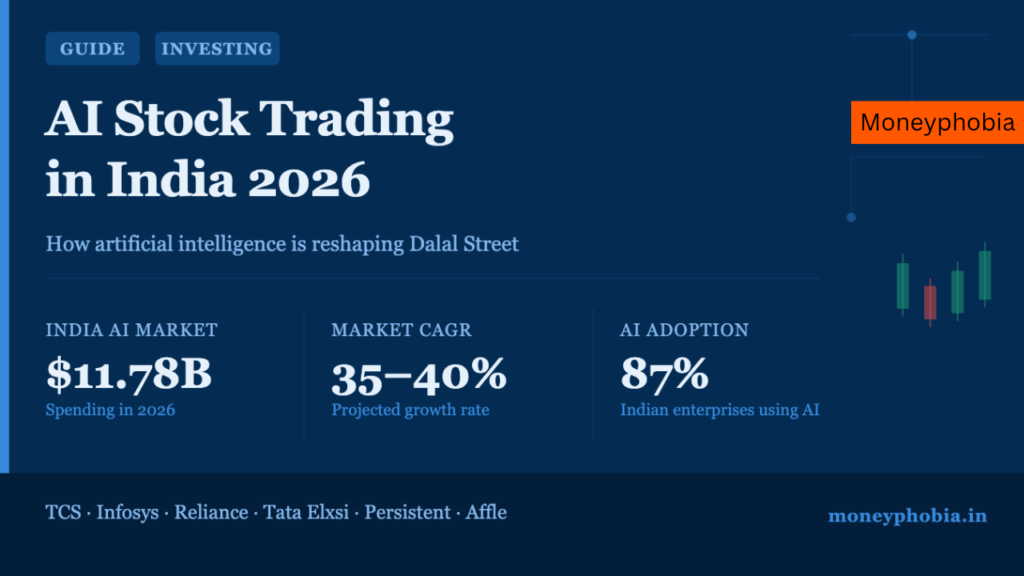
The numbers behind India’s AI story are hard to ignore. India’s AI spending is projected to surpass $11.78 billion in 2026, and the market is at a critical tipping point for investors. The government has put serious money behind this Budget 2026-27 allocated ₹1,000 crore to support AI compute infrastructure, datasets, innovation, startups, skilling, and the safe development of AI. On the corporate side, Reliance Industries and Jio have committed ₹10 lakh crore (~$110 billion) over seven years, covering the entire AI value chain from NVIDIA GPU-powered compute backbone to AI model development.
India’s AI industry is rapidly evolving, with forecasts of reaching more than $7 billion by the end of 2026, and growing to more than $35 billion by 2032 at a CAGR of 29.9%. Almost 89% of newly launched startups use AI, with generative AI funding reaching ₹4,442 crore as of Q2 FY25.
How AI is used in trading today
AI enters the trading process at multiple points. Algorithmic systems use machine learning to identify patterns in historical price data and execute trades based on pre-defined signals faster and more consistently than any human trader. Sentiment analysis tools scan earnings call transcripts, news feeds, and social media in real time to gauge market mood before price moves. Portfolio optimisation engines use AI to balance risk and return across thousands of securities simultaneously. And increasingly, AI is being used for fraud detection, credit risk assessment, and regulatory compliance in the broader BFSI ecosystem.
For Indian retail investors, the most accessible entry point is through AI-powered stock screeners and research tools platforms that use machine learning to surface undervalued stocks, flag deteriorating fundamentals, or identify sectoral rotations before they become consensus trades. As of early 2026, the AI boom is facing a “show me” moment investors are looking for concrete revenue and profit growth rather than just hype.
Top AI stocks in India to watch in 2026
Rather than chasing pure-play AI companies (most of which are unlisted in India), the smarter approach is to identify listed companies with deep, monetisable AI integration. Here are the key names across categories:
| Company | Category | AI angle | Cap type |
|---|---|---|---|
| TCS | IT Services | AI-led automation, cognitive computing | Large cap |
| Infosys | IT Services | Infosys Nia — AI analytics platform | Large cap |
| HCL Technologies | IT Services | AI + cloud + cybersecurity integration | Large cap |
| Persistent Systems | IT Services | Faster AI-led growth vs. large peers | Mid cap |
| Tata Elxsi | Design & Tech | AI in automotive, media, healthcare | Mid cap |
| Reliance / Jio | Conglomerate | $110B AI infra + data centre buildout | Large cap |
| Affle India | Ad Tech | AI-driven mobile marketing & analytics | Small/mid |
| Bosch India | Auto/Industrial | AI in IoT, automation, connected cars | Large cap |
For most retail investors, the answer is not to build or buy an AI trading system it is to use AI-augmented research tools to make better-informed decisions. Platforms like Tickertape, Jarvis Invest, and Smallcase already embed AI into stock screening and portfolio building. These tools help you filter noise, stay disciplined during volatile markets, and identify opportunities that manual research might miss.
A balanced approach that includes both large, stable firms and mid-sized high-growth companies can provide better diversification, combining steady returns with opportunities for higher growth in the AI sector. The risk to watch: high valuation risk AI-linked stocks can attract strong market attention, which may push valuations ahead of actual earnings growth.
The bottom line for Indian investors: AI is not a trade — it is a multi-year structural shift. The companies building, deploying, and monetising AI across India’s economy are likely to be among the most rewarding long-term holdings on the NSE and BSE. But as with any powerful theme, entry price, earnings visibility, and patience matter more than the excitement of the story.
This article is for educational and informational purposes only. It does not constitute investment advice. Please consult a SEBI-registered financial advisor before making any investment decisions. | moneyphobia.in
For Advertising, Guest Posting, Newsletter Inserts please contact editor@moneyphobia.in. For general enquiries contact cfo@moneyphobia.in.

Recent Posts
Could Gold (XAU/USD) Cross $6,000 in the Coming Months?
Tukaram Mundhe Biography: Age, Education, IAS Career, Wife, Family, Salary, Net Worth & More
NISM-Series-XV: Research Analyst Certification Examination
NISM-Series-II-A: Registrars to an Issue and Share Transfer Agents (Corporate) Certification
NISM-Series-I: Currency Derivatives Certification Examination
Ravneet Singh Bittu: Biography, Age, Education, Wife, Political Career, Net Worth & More
Pawan Kumar Chandana: Biography, Age, Education, Net Worth, Wife, Skyroot Aerospace & More
Aryan Kelvin (Aman Pandit): Age, Biography, Height, Village, Net Worth & More
OFSS Bihar Portal 2026: Complete Guide for 11th Admission, Login, Merit List & Spot Admission
Skyroot Aerospace Vikram-1 Launch: India's First Private Orbital Rocket Set for Historic Mission
Abhijeet Dipke Joins Protest at Jantar Mantar, CJP Raises Concerns Over Civil Rights
JPMorgan Invests $24 Million to Boost US Shipbuilding Industry