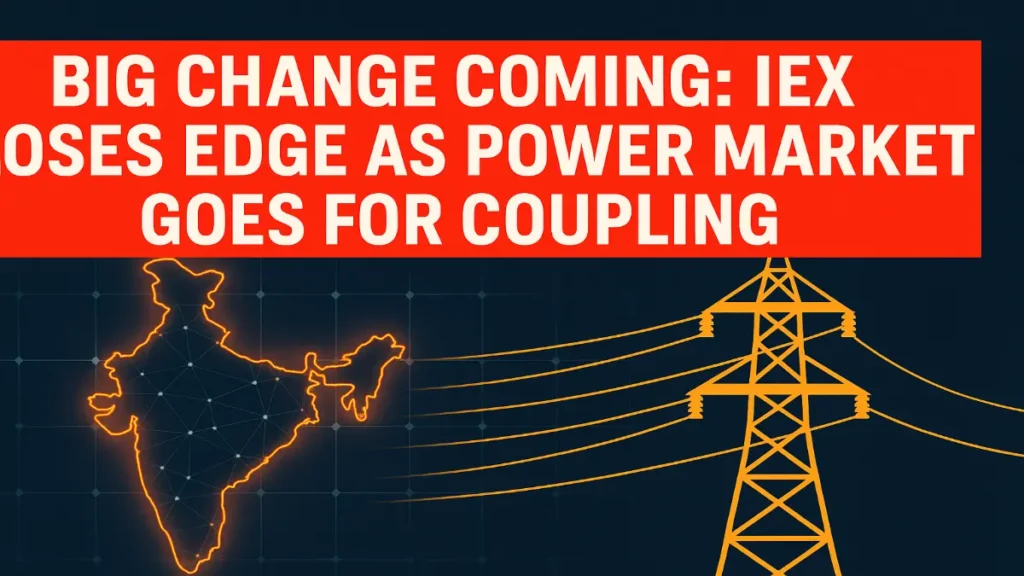
Something big is about to change in India’s electricity market. The Central Electricity Regulatory Commission (CERC) has cleared the way for market coupling, and it kicks off in January 2026.
This isn’t just another policy update. It’s a major shift that could rewrite how electricity is traded — and how dominant players like Indian Energy Exchange (IEX) run their business.
Right now, power exchanges like IEX, PXIL, and HPX set their own prices. Traders, companies, and state boards place their bids, and each exchange runs its own show. But soon, that game is going to change.
So What’s Market Coupling?
Think of it like this — instead of each power exchange setting its own price, all of them will now be forced to work together. All buy and sell orders will be pulled into one central system. That system will find a single market price for electricity across the country.
No more separate prices for the same unit of power across different exchanges.
The first part of this will start with the Day-Ahead Market. After that, if all goes well, Real-Time and Term-Ahead markets will follow.
Each exchange will take turns running the system, like passing the mic around. A company called Grid-India will act as the fallback operator — ready to jump in if anything goes wrong.
What Does This Mean for IEX?
This is where things get interesting.
IEX has had a huge advantage for years. It’s the biggest player, controlling around 90% of the day-ahead market. It’s known for smooth operations and reliable price discovery.
That edge? Pretty much gone once market coupling kicks in.
The news broke, and investors didn’t like what they heard. IEX shares plunged 30% in a day. From ₹159 to ₹132. A massive drop, and the biggest in years.
But the next day, something unexpected happened. IEX posted its Q1 results. Profit jumped 25% compared to last year. The stock made a comeback — at least for now.
Will It Get Worse or Better?
Well, that depends.
Some analysts think this could hurt IEX for the long haul. Bernstein, a global research firm, cut its rating on the stock and lowered the target price to ₹122. They expect earnings per share to fall by around 30% if more markets are coupled in the future.
A pilot project that tested this new system between December and March showed only a small gain — about ₹38 crore — for the country. Not bad. But not a game-changer either.
For the government and regulators, this move is about fairness. Making sure everyone plays by the same rules. No one exchange should control the market.
How IEX Plans to Fight Back
Losing price discovery power doesn’t mean IEX is going to sit quietly.
They’re looking for new ground. Plans are in motion to grow in:
- Cross-border electricity trade (Nepal, Bhutan, Bangladesh)
- Renewable energy markets
- Gas and environment-related trading
- Long-term contracts and virtual power deals
If they pull this off, they might build a new kind of dominance in areas that haven’t even matured yet.
Where Does This Leave Us?
We’re standing at a crossroads. Market coupling will level the playing field. Smaller exchanges like PXIL and HPX could grab a bigger slice of the pie. The big players will need to adjust — and fast.
For traders, this shift may bring more consistent pricing. For investors, especially those watching why IEX is down today — this is your answer. This is no longer just about scale. It’s about who adapts quickest in a system where everyone has to play fair. Big shifts often look messy in the short term. But they open the door to new players, new ideas, and new power centers.
If you’re watching the energy sector, this is one of those stories you don’t want to miss.
For Advertising, Guest Posting, Newsletter Inserts please contact [email protected]. For general enquiries contact [email protected].

Recent Posts
Pawan Kumar Chandana: Biography, Age, Education, Net Worth, Wife, Skyroot Aerospace & More
Aryan Kelvin (Aman Pandit): Age, Biography, Height, Village, Net Worth & More
OFSS Bihar Portal 2026: Complete Guide for 11th Admission, Login, Merit List & Spot Admission
Skyroot Aerospace Vikram-1 Launch: India's First Private Orbital Rocket Set for Historic Mission
Abhijeet Dipke Joins Protest at Jantar Mantar, CJP Raises Concerns Over Civil Rights
JPMorgan Invests $24 Million to Boost US Shipbuilding Industry
Offshore Wind Power Faces Fresh Challenges Under Trump Administration Policy
US Gas Prices Edge Higher After Fresh US-Iran Tensions Shake Oil Markets
Reliance Industries Q1 Results 2026: Profit Beats Estimates as Jio and O2C Drive Growth
SBI IPO Allotment Status 2026: How to Check on KFinTech, BSE and NSE
Indian Stocks Show Mixed Earnings as Mideast Worries Trigger Downgrades Says Jefferies - Investing.com
Punjab National Bank stock (INE692A01016): shares firm on latest quarterly results and Indian bankin - AD HOC NEWS