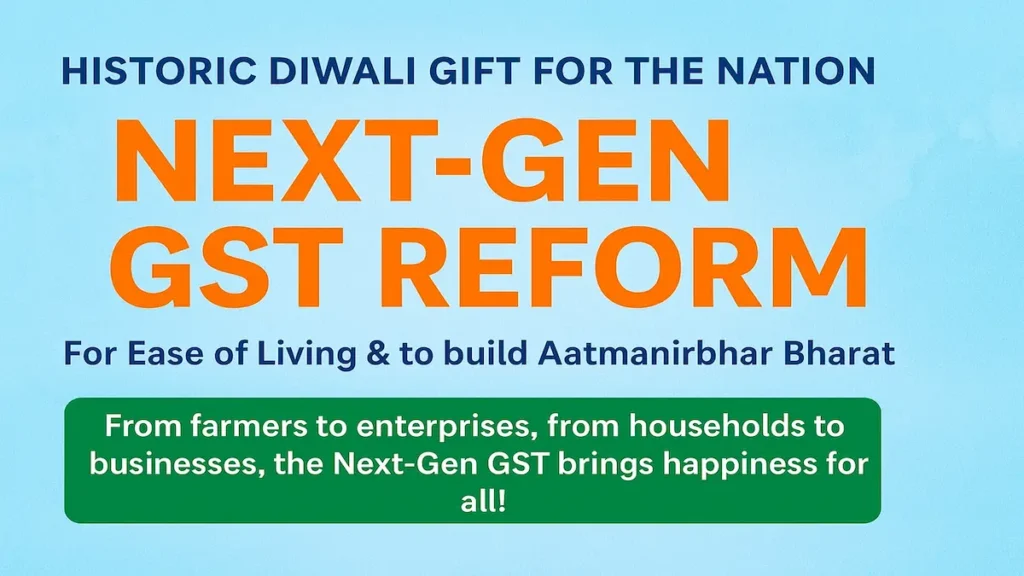
The Government of India has announced a new Goods and Services Tax (GST) reform ahead of Diwali. The reform has been described as a historic step to bring ease of living and to strengthen the vision of Aatmanirbhar Bharat. The government has reduced GST rates on many essential products, education items, healthcare goods, farm equipment, automobiles, and electronic appliances. The new rules are being called the Next-Gen GST Reform.
The objective of this reform is simple. People will spend less on daily goods. Farmers and students will get direct benefits. Healthcare will become affordable. Businesses, especially MSMEs and small traders, will see more growth. Everyday savings for households will also add to overall economic activity.
Cheaper Daily Essentials
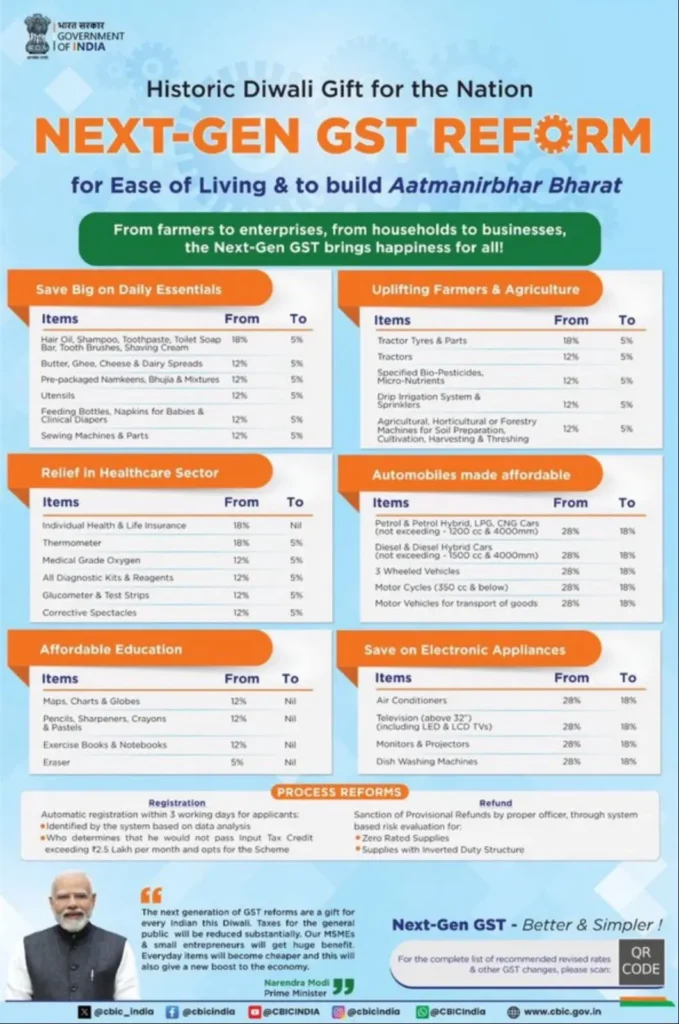
The new GST rate cuts will directly reduce household budgets. Items like hair oil, shampoo, toothpaste, toilet soap, toothbrushes, and shaving cream will now attract only 5 percent GST instead of 18 percent. Dairy items like butter, ghee, cheese, and spreads will now come under 5 percent instead of 12 percent.
Pre-packaged namkeens, bhujia, and mixtures will now attract 5 percent GST. Utensils, feeding bottles, baby napkins, and clinical diapers have also shifted to 5 percent. Even sewing machines and parts have been brought down from 12 percent to 5 percent.
This move is expected to make daily life more affordable for millions of households.
Benefits for Farmers and Agriculture
Farmers have received special attention in this reform. Tractor tyres and parts which earlier attracted 18 percent GST will now be taxed at only 5 percent. Tractors, bio-pesticides, micro-nutrients, drip irrigation systems, and sprinklers will also come under 5 percent GST instead of 12 percent.
Agricultural, horticultural, and forestry machines used for soil preparation, cultivation, harvesting, and threshing will also now fall under 5 percent. This reduction will help reduce the input cost for farmers and encourage modern equipment usage in agriculture.
Relief for Healthcare Sector
The GST reform provides big relief in healthcare. Individual health and life insurance will no longer carry GST. The rate has been reduced from 18 percent to zero. Medical items like thermometers, oxygen cylinders, diagnostic kits, glucometers, and test strips have been reduced to 5 percent GST. Corrective spectacles also now fall under 5 percent.
This move will lower the burden of healthcare costs on families and support the medical sector in India.
Affordable Education
Education has been given special focus. GST on maps, charts, and globes has been reduced from 12 percent to zero. Pencils, sharpeners, crayons, and pastels have also been exempted. Exercise books, notebooks, and erasers will now be tax-free as well.
By removing GST on basic education supplies, the government is trying to make learning affordable and accessible to every student.
Automobiles Become Affordable
The GST cut also extends to the automobile sector. Petrol and petrol hybrid cars, LPG cars, and CNG cars up to 1200cc engine capacity and 4000mm length will now attract 18 percent GST instead of 28 percent. Diesel and diesel hybrid cars up to 1500cc engine capacity and 4000mm length will also move to 18 percent.
Three-wheeled vehicles, motorcycles up to 350cc, and vehicles used for transport of goods will all now fall under 18 percent GST instead of 28 percent. This reduction will make mobility more affordable and may encourage higher sales in the automobile sector.
Lower Prices for Electronic Appliances
Electronic appliances have also received a price cut. Air conditioners, televisions above 32 inches including LED and LCD models, monitors, projectors, and dishwashing machines will now attract 18 percent GST instead of 28 percent.
This move will help households upgrade their appliances at lower costs and support growth in consumer demand.
Process Reforms
Along with rate cuts, the reform introduces simpler processes. Applicants will now get automatic GST registration within three working days. Refunds will be sanctioned quickly through system-based evaluation. This includes refunds for zero-rated supplies and inverted duty structures.
The simplified process will reduce compliance pressure for small businesses and entrepreneurs.
Government’s Statement
Prime Minister Narendra Modi has described this reform as a gift for every Indian during Diwali. He said that taxes for the general public will reduce substantially. MSMEs and small entrepreneurs will benefit. Everyday items will become cheaper, and the economy will get a new boost.
The Next-Gen GST Reform is one of the biggest tax changes in recent years. It reduces GST rates on essential goods, education, healthcare, agriculture, automobiles, and electronics. It also introduces easier registration and refund processes.
For households, the change means direct savings. For farmers, it lowers input costs. For students, education materials are now more affordable. For healthcare, essential products will be cheaper. For businesses, the system becomes more supportive.
Overall, this reform is expected to improve the cost of living for families, give relief to farmers and patients, and promote growth in industries. It is truly being seen as a Diwali gift for the nation.
Next-Gen GST Reform: Old vs New Rates
| Category | Items | Old GST Rate | New GST Rate |
|---|---|---|---|
| Daily Essentials | Hair oil, shampoo, toothpaste, toilet soap bar, toothbrushes, shaving cream | 18% | 5% |
| Butter, ghee, cheese, dairy spreads | 12% | 5% | |
| Pre-packaged namkeens, bhujia, mixtures | 12% | 5% | |
| Utensils | 12% | 5% | |
| Feeding bottles, baby napkins, clinical diapers | 12% | 5% | |
| Sewing machines & parts | 12% | 5% | |
| Agriculture | Tractor tyres & parts | 18% | 5% |
| Tractors | 12% | 5% | |
| Specified bio-pesticides, micro-nutrients | 12% | 5% | |
| Drip irrigation system & sprinklers | 12% | 5% | |
| Agricultural/forestry machines for soil preparation, harvesting, threshing | 12% | 5% | |
| Healthcare | Health & life insurance | 18% | Nil |
| Thermometer | 18% | 5% | |
| Medical grade oxygen | 12% | 5% | |
| Diagnostic kits & reagents | 12% | 5% | |
| Glucometer & test strips | 12% | 5% | |
| Corrective spectacles | 12% | 5% | |
| Education | Maps, charts, globes | 12% | Nil |
| Pencils, sharpeners, crayons, pastels | 12% | Nil | |
| Exercise books & notebooks | 12% | Nil | |
| Erasers | 5% | Nil | |
| Automobiles | Petrol, hybrid, LPG, CNG cars (≤1200cc & 4000mm) | 28% | 18% |
| Diesel, hybrid cars (≤1500cc & 4000mm) | 28% | 18% | |
| Three-wheeled vehicles | 28% | 18% | |
| Motorcycles (≤350cc) | 28% | 18% | |
| Motor vehicles for goods transport | 28% | 18% | |
| Electronics | Air conditioners | 28% | 18% |
| Televisions above 32” (including LED & LCD) | 28% | 18% | |
| Monitors & projectors | 28% | 18% | |
| Dishwashing machines | 28% | 18% |
For Advertising, Guest Posting, Newsletter Inserts please contact [email protected]. For general enquiries contact [email protected].

Recent Posts
Indian Stocks Show Mixed Earnings as Mideast Worries Trigger Downgrades Says Jefferies - Investing.com
Punjab National Bank stock (INE692A01016): shares firm on latest quarterly results and Indian bankin - AD HOC NEWS
Ahluwalia Contracts (India) Ltd Reports Positive Financial Trend Amid Mixed Quarterly Results - Markets Mojo
Indian Energy Exchange Ltd Reports Record Quarterly Performance Amid Flat Financial Trend - Markets Mojo
Power Grid Corporation of India Q1 Results - Mint
Union Bank of India Q4 Results 2026 - Find Union Bank of India Q4 Earnings Result | UNIONBANK Q4 results - Mint
Bata India Ltd. Reports Sharp Decline in Quarterly Performance Amid Negative Financial Trend - Markets Mojo
IndiGo stock drops over 2% ahead of Q4 results as investors track fuel cost impact - Moneycontrol.com
Share market news: This logistics stock with 38% return in 1 year to be in focus as company declares quarterl - India.Com
Q4 results: Ashok Leyland, Alkem Labs, Finolex Cables, 469 more on May 28 - Business Standard
Cummins India Q4 Results: Stock jumps 10% after earnings beat; Dividend payout highest ever - CNBC TV18
Asahi India Glass Surges Over 2% Ahead of Quarterly Results; Weekly Chart Shows Sharp Uptrend - HDFC Sky